Thursday, July 28, 2011

Miral- A Review: Book and Film

So... I sort of love Julian Schnabel. I love Julian Schnabel. I loved Julian Schnabel? I don’t know where to start...

A few years ago, before I had ever heard of the man I saw a little film called Before Night Falls. The film left me breathless with its beauty and perfection.
Before Night Falls is based on the autobiography of the same name by Cuban poet and novelist Reinaldo Arenas. In the film, Arenas, who was openly gay, is born in Oriente in 1943 and raised by his single mother and her parents, who soon move the entire family to Holguín. After moving to Havana in the sixties to continue his studies, Reinaldo begins to explore his ambitions, as well as his sexuality. After receiving an honorary mention in a writing contest, Arenas is offered the chance to publish his first work. Read more. 


Wanting to know what had been translated from text to film, I read the book shortly after watching the film, (The soundtrack is first rate as well) but was disappointed by the dry lifelessness of the prose. Like a magician, Schnabel has given the flat novel life and filled it with color and emotion. Completely satisfied with my first Schnabel experience, I was ready to explore.

I immediately watched  Basqiuat, another masterpiece. This time about Jean-Michel Basquiat:
an American artist. His career in art began as a graffiti artist in New York City in the late 1970s, and in the 1980s produced Neo-expressionist painting. Basquiat died of a heroin overdose on August 12, 1988, at the age of 27. Read more.

Once again, Schnabel exposes the idiosyncrasies and passion of art through the medium of film. His films blend content and form, subject and medium, leaving only a bricolage of artistic sensibilities. Scenes, characters, music all layered effortlessly to create a documentary like vision of  his subjects and the worlds they inhabit. Two for two. Loving Schnabel.

Next came, The Diving Bell and the Butterfly a much slower and emptier film. It is:
the true story of Elle editor Jean-Dominique Bauby who suffers a stroke and has to live with an almost totally paralyzed body; only his left eye isn't paralyzed.

What it lacks in plot, the film makes up for with signature Schnabel colors, camera movement as story teller, and a soundtrack that acts as part character/part narrator. I was not crazy about it, but The Diving Bell is a solid film without a doubt. I am only disappointed that I have yet to read the book. It is still on my list.

Wow! What an introduction. This post was meant to be about Schnabel's latest film, Miral. When I first stumbled across the synopsis of the film, I knew it warranted some research. I quickly learned it was based on a book about the life of Rula Jebreal who is apparently Schnabel's girlfriend. I read up on the story:
A chronicle of Hind Husseini's effort to establish an orphanage in Jerusalem after the 1948 Arab–Israeli War, the Deir Yassin Massacre, and the establishment of the state of Israel.

Jerusalem, 1948. On her way to work, Hind Husseini comes across 55 orphaned children in the street. She takes them home to give them food and shelter. Within six months, 55 had grown to almost 2,000, and the Dar Al-Tifel Institute was born.

In 1978, at the age of 7, Miral was sent to the Institute by her father following her mother's death. Brought up safely inside the Institute's walls, she is naïve to the troubles that surround her. Then, in 1988, at the age of 17, she is assigned to teach at a refugee camp where she is awakened to the reality of the Palestinian refugees. When she falls for Hani, a militant, she finds herself torn between the First Intifada of her people and Mama Hind's belief that education is the road to peace. Read more
 I watched the trailer and ordered the book: 


I wanted to start from the source this time and see where Schnabel would go. I wanted to see if I could guess what he would emphasize, what he would leave out. The novel, which is autobiographical and based on a true story, starts off a bit journalistic and dry, but quickly rushes toward melodrama. Somewhere in the middle, the story finds a perfect equilibrium and becomes riveting. I read over one-hundred pages in one sitting. The interwoven story lines and characters make for a powerful emotional web spun across one of the most divisive conflicts the world has ever known. Never overtly political or personal, Miral finds the balance between the two human conditions and begs you to define the difference.

It is a must read for anyone looking to gain a basic understanding of the Israeli Palestinian conflict. While not completely objective and unbiased, it is honest in its direction. It is a human story of love, failure, anger and eventually peace.  The characters like the nations they represent must learn how to be themselves before they can ever learn to understand the enemy.

So there I was last night: research done, book read, ready to see Schnabel do his thing...and it was a disaster. How he took a text filled with life, turmoil, conflict, emotion, set against a backdrop of war and peace, and the beautiful city of Jerusalem, and create a fragmented, dull, series of poorly acted scenes is beyond me.

Schnabel has taken a group of amazingly complex characters, mostly women, and turned them into caricatures and unlikable mannequins. The plot never flows, and if I had not read the book, I would not have felt any connection to any of it.

I wanted to love it, but this film does not do this story justice. I recommend you read the book and wait for Schnabel's next work. Hopefully, he will focus on another eccentric and doomed artist, Kurt Cobain perhaps, Elliot Smith would be a dream come true, and leave the politics to those more adept.

Wednesday, July 27, 2011

Our Story

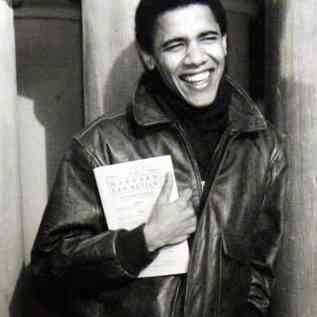
When Ari asked me to read Obama’s book, I hesitantly bought and read Audacity of Hope. It is a lukewarm campaign book, that I actually enjoyed. It is political in nature and written on a level I could understand and appreciate. Although tinted with a personal varnish, it is still a manifesto of sorts, written by a politician climbing a power ladder. It is a face. A poster. Barely authentic. Likable. American.

After I proudly told Ari, that I had read Audacity of Hope, he curtly responded, “Oh really? That was the wrong book. I actually meant that you must read Dreams of My Father.”

I did. He was right. Now I am asking you to please read it too. While Audacity of Hope is a political soul-search of sorts, Dreams of My Father is a search of a different kind. It is the story not of a president, but of a man in search of himself. It is the story of us all. It is the story of our families and the disappointing skeletons we have dressed as ancestral heroes. It is the story of race, nation, and identity. It is the story of humanity.

Written before Obama was a Senator, the book is rough and raw and honest. Beautifully written, it reads like novel full of complex characters and plot twists. Forget everything you think you know about Obama. Forget he is even the president and read this book like you would a work of fiction. No matter your thoughts on Obama the politician, this book is a must read. That is the end of my formal review. The end of my request that you read the book.

I want to spend the next few paragraphs dancing with my own thoughts on one of the themes I found the most compelling: Identity.
I had been forced to look inside myself and had found only a great emptiness there.
As a Third Culture Kid, I have spent way too much time trying to find a balance with my hyphen. Iranian-American? Sounds like an oxymoron. Could there be more opposing forces. As a child, newly arrived in the USA in the 1980’s, I felt like a bizarrely sculpted Siamese-twin-- born of two enemies. I spent so much energy defending both sides from each other. I defended Iran from my friends and American from my parents. The pressure of animosity from American culture was compounding: angry-muslim-terrorists? Really? My grandmother is the kindest person I know. Our music is sensual. Our poetry ancient. Our cuisine complex. On the other side, Americans: fat-stupid-lazy-imperialist. Really? Berkley seems petty cool. Have you heard of Bob Dylan? I never knew who to be. It is only recently that I have erased not only the hyphen but the twins as well. You can have American, Iranian all of it.
The constant, crippling fear that I didn’t belong somehow, that unless I dodged and hid and pretended to be something I wasn’t I would forever remain an outsider, with the rest of the world, black and white, always standing in judgment.
Obama also struggled with a murky identity. Born to a white American woman and a Kenyan father, raised in Indonesia and Hawaii, Obama spent much of his youth trying to first find out who he was, later to shape that identity.  The irony is that he has very little connection to the African-American community of which he has somehow been painted the symbol.

As Obama, true for me too I suppose, tried to create his identity, he repeatedly grasped for a variety of romantic ropes, lose ends really. First, he created the myth of his father, his grandfather, his tribe, his continent. Everything that was out of reach seemed to be what he needed to complete himself. Every time he leaned on some romantic vision of the very thing that he felt would complete him, he would begin to understand that his father, his grandfather and even Africa were flawed and broken. Just as he was. He is. I am. You are.
A circle was beginning to close, so that I might finally recognize myself as I was, now, in one place.
There is much more to say about this book, but I have seemed to hit a dead end tonight.  I have written enough about Obama lately, so I will close by saying that this book has touched me in a way that few books have. It is an important story that needs to be shared, as it is our story. It is the story of a melding of worlds. It is the story of global citizens and cultural blends. It is the story of our new world.

Tuesday, July 19, 2011

Hard to Know

Sifting through old posts, it appears I have written quite a bit about Barack Obama on this blog. I have spent the last hour reading old posts, at times feeling proud of my growing body of thoughts on the man, while other times I found myself feeling a bit ashamed for making such rash judgments about him, never having read his books. I am more than half way through Dreams From My Father, (I read and wrote about Audacity of Hope a few months ago) and I find myself torn about Obama and his story.

Before I continue, no matter your political affiliations, might I recommend that you read Dreams From My Father to gain a deeper insight on Obama the man, not the politician. Page after page, I am left in awe of his story, and in a weird way, I have found many similarities to my own struggles, both with politics, but more importantly simply becoming a man. Yes! I am comparing myself to the president of the United States; my ego knows no bounds.

There are many directions this post could take, but I for now, I simply wanted to write about the idea of selling-out. Last night, as I was reading about Obama’s days as a community organizer in Chicago, with goosebumps on my skin, flipping the pages filled with admiration and respect for him, I stopped and said to my wife, “I feel so sorry for him. He is too smart to be the president of the USA.  He is too wise, too kind, too reflective to be a politician. He must be a mess sitting in the White House. Either he has sold out his entire set of values and now deals with the nagging guilt of turning his back on everything he believes in, in order to bow down to his Goldman Sachs sugar daddies, or worse, he sits in the most powerful office in the world impotent and powerless to do the things has worked for his entire life. Either way he would serve the world much better back in Chicago!”

Then I heard Ari’s voice in my head. Speaking about me, “I feel so sorry for him. He is too smart to be the teacher at a private school in Asia.  He is too wise, too kind, too reflective to be a teacher working a corporate school. He must be a mess sitting in his huge house. Either he has sold out his entire set of values and now deals with the nagging guilt of turning his back on everything he believes in, in order to bow down to his corporate sugar daddies, or, worse he sits in the state of the art school impotent and powerless to do the things has worked for his entire life. Either way he would serve the world much better back in the Bronx or Africa!”
"It is hard to know who is selling out and who is doing their best, if that person is not you."
Who am I to sit and judge this man, when I have no idea what stirs his heart? It was much easier to call him a corporate hack, before I read this book, but now that I have, it is much more difficult to understand what he is doing and why.

I know I have justified my move from working on the ground for social justice to a more comfortable situation. We can all justify everything we do and feel fine about it, only to turn around and berate others for doing the exact same thing. It takes an open, critical and objective mind to see yourself in others and others in you.

Perhaps Obama is waiting for his second term to return to his roots. Perhaps he thought that he could do more while compromising with the obstructionist Republicans. Perhaps  I feel that by educating wealthy Asians, I can create a more just and sustainable world. Which one sounds more absurd? You tell me.

The truth is that revolution, while a handy T-shirt slogan, takes a lot of guts and sacrifice. It is easy to sit on the sidelines and cheer and jeer as politicians come up short and disappoint us for not being as revolutionary as we want them to be. But the truth is that the system we want to topple, reform and  change is massive.

I am not sure if writing these little posts and teaching kids about the ills of the market economy, while I myself participate in it whole heartedly, is the way toward this change, but it is the path I have chosen. Who am I to say that Obama has sold out?


All I know for now, is that the man who wrote, Dreams From My Father, has to still be alive somewhere in the White House. You cannot outgrow that kind of passion. He is very different from the man giving the State of Union speeched and sending more troops to Afghanistan,  of that there is no doubt, but something about him has to be the same. I have to believe this to be true, because I know that the pieces of me--the ones that commuted into the Bronx or lived in Africa for two years--are still stirring in me.


More thoughts to come I am sure. But in the meantime, what do you think? How do you deal with the feeling of selling-out?

Monday, July 18, 2011

Gain- A Review

If I don’t write this post/review right now, tonight, I will never write it. It has been festering beneath my skin, down near my bones for a little over a week. I keep telling myself to wait till the time is right. Wait until it comes oozing out and the words write themselves, but I am not sure when that time will come, so before this post becomes infected and pusses into a disgusting wound, I will try to get it out.

I am having a difficult time sharing my thoughts on the novel Gain by Richard Powers, because it could be one of the best books I have ever read. It deserves more than the sloppy stream of consciousness style post on which I am making my name. It needs a dissertation, a New Yorker article. At least a well planned essay. Perhaps I need to teach it as a graduate course novel, as Mary the person who recommended it to me, has done. But I haven’t the energy for such intellectual pursuits at this time. So let’s start with the basics:
In Gain, Richard Powers puts our modernity through the wringer once again. This time, though, he points the finger at one villain in particular: rampant, American-style capitalism, as exemplified by a conglomerate called Clare International. His novel, it should be said, is no piece of agitprop, but an intricate lamination of two separate stories. On one hand, Powers describes the rise (and fall and rise) of the Clare empire, beginning in its mercantile infancy. The author's Clare-eyed narrative amounts to a pocket history of corporate America, and a marvelously entertaining one. Lest we get too enamored of this success story, though, Powers introduces a second, countervailing tale, in which a 42-year-old resident of Lacewood, Illinois, is stricken with ovarian cancer. Lacewood happens to be the headquarters of Clare's North American Agricultural Products Division, and lo and behold, it seems that chemical wastes from the plant may be the source of Laura Bodey's illness.
These two stories are woven together with such subtle delicacy that I was left wanting at the end of each chapter. In the story about the rise of Clare, the reader is treated to a muck-raking ,journalistic narrative seeped in historical fiction. A clear and objective narrator tells the tale of a small soap company that transforms into a multi-national corporation over the course of a hundred years. The voice telling the tale is born of both Ayn Rand and Upton Sinclair, in that the reader is never quite sure what it is trying to tell about the rise of capitalism in the Untied States. At times, the narration is sharp and critical of the often ruthless purity of the American business-- “Industry’s raw inputs were endless, the land fecund enough for any machine dream. A nation come of age possessed no greater peacemaker than power.”

This is not solely an anti-capitalist tirade, however.  At times, Powers begs us to consider that perhaps business, tainted with it’s altruistic hue of science and technology, only exists to make our lives better and easier. But, no matter which side of the moralistic coin you choose to dwell, this is a novel that will force you to think about the current state of global capitalism by examining it’s history.


The novel acts as textbook for American history, economics, business, class struggle, marketing, as well as chemistry, environmentalism, and technology. It is a petri dish of discussion topics. But the beauty is that, it is not a textbook, but rather a beautifully crafted novel of intense beauty and poetry. The words drift and float leaving traces of sentences that when sorted into paragraphs leave lasting impressions. The sections of the book that tell the story of Clare, undertake a more formal tone, but are accented with hints of Whitman wordplay and Dickens storytelling in their charm and civility.

Then there is Laura. There is the cancer. The anguish. Tears and soft smiles and goosebumps. The deterioration of the same dream building up on the other side of history. Just as easily as Powers unleashed his powerful lecture on the rise and sometimes awe inspiring beauty of capitalism, with a voice of unquestionable expertise and authority, he now tells the fragile and honest story of a family in crisis in a voice much like Franzen.  A quick wit and humor infused with a underlying joyless reality are the back drop of the story of Laura’s cancer. The reader will be left laughing with tears in their eyes at the injustice of a disease that can only survive by growing beyond it’s means-- cancer or capitalism?

Please do not accuse me of hyperbole, when I say this is one of the best books you will ever read. I will read this book again. I will read everything Richard Powers has ever written. Someday I will teach this book. If you respect my opinion on anything, please do yourself a favor and read it.

Be warned, you will not look at the world the same again. It has altered the way I think about technology, science, marketing, America and the very objectives of our species--We have been taught to think that America is leading the train. That science and progress and technology and the cloak of marketing in which it has all been wrapped will save us from the terror that lurks in nature, that somehow the myth of Genesis married to Manifest Destiny, married to expansion and growth and progress and pre-emptive war and the American Dream will somehow save us. From what? No one stops to ask. There has to be something different out there...this novel will force you to stop and ask why you have never thought to question a system that is killing us all in one way or another.

Thursday, July 14, 2011

Kabuki Democracy- A Review

There is not much in this book that any decently informed liberal/progressive doesn't already know-- role of money in corrupting American politics, the obstructionist effects of the opposition party in deteriorating the very concept of government, the power of right-wing media outlets like Fox shaping what passes for political dialogue in the USA--are but some of the obstacles Eric Alterman explains in his latest book Kabuki Democracy.  But more importantly, he does a more than adequate job of stringing his ideas together to create a forceful, concise, and insightful narrative to help create a grassroots guide on what to do about it. 

This is not an Anti-Obama book, although he is critical of the (rightful or wrongful) feelings of betrayal that have been felt by many in Obama's leftist base. No. This is a clear look at the many obstacles that have stymied what ever candidate Obama may have wanted to do in his first years in office.

Not a book to share with your centrist friends, as they will no doubt accuse you of radical bias, but it is an effective Left-wing manual to help gather the troops and focus on what needs to be done to move America forward. Warning, it will not be easy, but it starts with all of us.

Wednesday, July 13, 2011

Coconut Paradise Villas- Review

It’s our last night at our house at the Coconut Paradise Villas in Rawai. There is a cool breeze and bursts of light showers, and I want to write a quick review about this amazing place. Let's start  with Ken and Sue the proprietors of this great outfit. I knew we were onto something special, when my wife first found the place, when I noticed that the official website was a blogspot blog and their pictures were hosted on Flickr, and like the unassuming web presence the Coconut Paradise Villas are a simple people oriented place.

We arrived to our two bedroom Coral Island Villa to a warm greeting by Sue to a comfortable, simple and well stocked house. She had stocked the kitchen with a few basics to tide us over before we got settled. The house has everything we have needed for the last four weeks: pots & pans, microwave, TV, towels, cribs, kids toys, and free Wifi. (When we lost Internet for a few days through no fault of Ken or Sue, they were more than accommodating by bringing us a USB modem. When that didn’t work because it was not Mac compatible, without even asking, Ken went out and bought a new one, until the Internet was back up. We were very impressed by how kind and attentive they both were for our entire trip.)

The town of Rawai itself gets a bum rap. It is classified as not a great tourist spot with mediocre beaches. But the truth is that, it is a quaint quiet town. The villas are situated in a low-key Thai neighborhood, surrounded by sleepy restaurants and a great coffee shop called Spoonful of Sugar. 

When we are young, we often have dreams of finding the most remote and rare beach spots. Dreams of The Beach force us to turn away from such accessible spots like Phuket, but Rawai is a perfect place for families who want to spend an extended time near a beach, under the sun and in the pool. With Nai Harn and Kota Noi within a few minutes drive, this is definitely an affordable way to spend a summer. We are already thinking about coming back next year and would recommend Coconut Paradise Villas to any of our friends.

Thanks Ken and Sue for creating such a friendly and perfect vacation spot. You are doing great work and we look forward to seeing you again very soon.

Saturday, July 09, 2011

Primetime

I think I may be in my prime. I have felt this way before, like the time I was bungee jumping off a crane in a crowded Mexican square as Hell’s Angles types cheered from down below, or the time I was doing my deep dive in Lake Malawi, or maybe the time I was cruising the coastline of Southern France on a scooter--just wed and Asiabound. There have been many times that everything in my life has felt like a runaway zenith, but never before this summer have I felt so comfortable with the man staring back at me in the mirror.

Despite the good times, I can also recall the many moments where he was ill at ease in his skin. Sagging rings under his eyes, too thin and pale. Scratching so hard to get to the surface. Lying to himself that the bottom wasn’t so bad. Pretending the loneliness was romantic and the angst turned rage just another head of the muse.

But not today. Not this now. Everything seems to be swimming in flow. The ebbs surmountable. Even enjoyable. It feels as if everything up to now has been a direct path to this moment in time. A moment where the direction is clear--it is all just a spiraling circle. I realize now that life is not linear and there really is no destination. We wake up every morning and try to maintain the high. Not in the form of escape or even enhancement, but rather a clear awareness of reality as it is.

I used to think that everything in life could be better if I had one more drink, ran a  little faster, was a little more adventurous. Life doesn’t need to be any better than it always is. A warm safe bed. A gentle breeze. The hot sun. A budding sense of humor. Her scowl as she becomes a person. A soft tune. Rubbing her back as we escape in fiction for a brief moment each night. A carefully crafted paragraph of prose. Satisfaction from work. A teachable moment. A lesson learned.


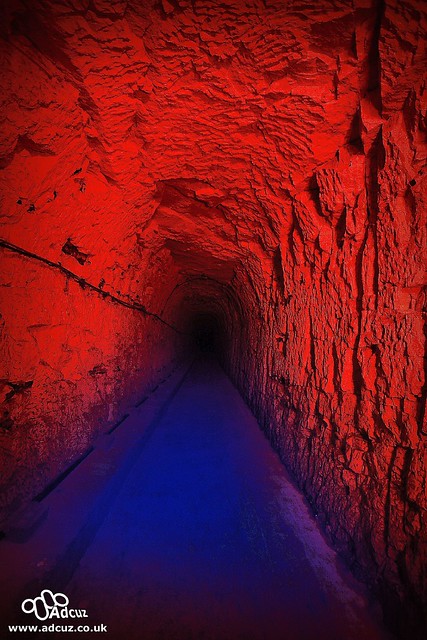
by Adcuz
I take back what I said earlier. I am not in my prime, because such an assumption presupposes that there is a limit. An apogee to our lives. I am merely at a clearing on my path. A spot where the past is bathed in the sweet summer sun and the future summits and valleys are made obvious. Perhaps being in one’s prime is the realization that there is no prime. There is no,  this is how it should be. No successes. No happiness. Just a meta-aware existence that can look into the mirror of the present moment and not shudder with anxiety or fear, but smile, nod, toss the hair out of its face and carry on.

Thursday, July 07, 2011

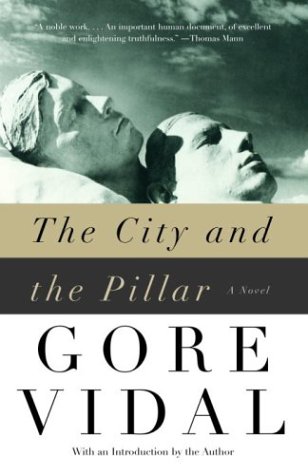
The City and the Pillar- A Review

I have read a lot of Gore Vidal. I am not being hyperbolic when I say I love him. He has got to be one of the best writers of the twentieth century. A few months ago, I finished Palimpsest: A Memoir and Point to Point Navigation: A Memoir, in which he wrote at length about The City and the Pillar...(wikipedia)
...written in 1946 and published on January 10, 1948. The story is about a young man who is coming of age and discovers his own homosexuality.

The City and the Pillar is significant because it is recognized as the first post-World War II novel whose openly gay and well-adjusted protagonist is not killed off at the end of the story for defying social norms. It is also recognized as one of the "definitive war-influenced gay novels", being one of the few books of its period dealing directly with male homosexuality. In addition, it was among the few gay novels reprinted in inexpensive paperback form as early as the 1950s.
I knew I had to read it. Publishing this book in 1948 was all but suicide for Vidal, not only in terms of his writing career, but also for his political ambitions. He was advised never to publish such an overtly homoerotic book, “An editor at EP Dutton said to Vidal, "You will never be forgiven for this book. Twenty years from now you will still be attacked for it." But publish it he did.


The novel itself is nothing special, but the themes he exposes were, and unfortunately still are, groundbreaking.
One major theme is the portrayal of the homosexual man as both normal and masculine. Gore set out to break the mold of novels that up until The City and the Pillar depicted homosexuals as transvestites, lonely bookish boys, or feminine. Gore purposefully makes his protagonist a strong athlete to challenge superstitions, stereotypes, and prejudices about sex in the United States. To further this theme Vidal wrote the novel in plain, objective prose in order to convey and document reality.
One can’t help but admire Vidal’s strength and courage. This book surely opened doors for the entire Beat Generation, Harvey Milk, and others struggling to be gay and normal in America. The City and the Pillar is a timeless novel as the world comes to terms with what it means not only to be gay, but also for what it means to be a man. It is a shame that this book is not read and discussed more in schools, where it would surely help many young men pass the terribly difficult and painful experience of becoming men.

The Book of Dave- A Review

Before I left for summer,  a colleague at work gave me a copy of The Book of Dave by Will Self and suggested that I take it with me as summer reading. Never one to directly say no to a book, I said sure and packed it as my only summer book. Tipping the scale at nearly five hundred pages, I figured it would keep me busy.


Let’s start with a brief review; what better place to start that the Wikipedia synopsis:
The Book of Dave tells the story of an angry and mentally-ill London taxi driver named Dave Rudman, who writes and has printed on metal a book of his rantings against women and thoughts on custody rights for fathers. These stem from his anger with his ex-wife, Michelle, who he believes is unfairly keeping him from his son. Equally influential in Dave's book is The Knowledge—the intimate familiarity with the city of London required of its cabbies.

Dave buries the book, which is discovered centuries later and used as the sacred text for a dogmatic, cruel, and misogynistic religion that takes hold in the remnants of southern England and London following catastrophic flooding. The future portions of the novel are set from 523 AD (After Dave).The book alternates between Dave's original experience and that of the future devotees of the religion inspired by his writings.
As is the case with most dystopian novels, I began feeling lost and confused. I immediately regretted having strayed from my literally routine of handpicking each book I read. The novel begins in a bizarre futuristic English landscape where the characters speak in a muddled language called Mokni, an invented dialect of English derived from Cockney, taxi-drivers' and Dave's own usages, text-messaging, and vocabulary peculiar to the late 20th and early 21st centuries.

It took about a hundred pages and a trip back to the twentieth century for me to finally find my footing in the language. But once I did, I began to see the beauty of what Self was doing- Using a sharp and critical satirical prose, he carefully crafts an intricate novel of amazing depth. There is not much more to say- there is never a point where The Book of Dave is not extremely well written. The stories from the past, present and future seamlessly intertwine to create a biting mirror reflecting the hypocrisy and absurdity of religious dogma. I will end the review here, by saying that this is a novel that is worth your time. Before I end this post, I did want to make some comments about the thoughts that were alighted because of this text.

While I often expose an aggressive atheism, I like to think that I tote a robust and healthy spiritualism. I am a seeker and enjoy contemplating spiritual matters. Never one to shy away from discussions about the purpose of life, morality, or the human condition, I am always looking for conversations about topics steeped in mysticism and exploration.

What has always turned me off religious discussions is the certainty of truth. The reliance (faith) on dogma and holy books. The prescriptive rules and hoop jumping of organized salvation is not for me. Let me wallow in a Walt Whitman poem, or Rumi, or Bukowski, till I see a light that guides me through the darkness. Your “book” may be the outline that leads you to peace, but it lost me when it demanded that I should have dominion over all the creatures of the earth, or when it took it upon itself to classify certain forms of sexuality as abominations.

Be kind. Love your enemies. Show compassion. Treat others as I would like to be treated. These are ideas I can get behind, and honestly the holy books hold no monopoly on these ideas. 

What does any of this have to do with The Book of Dave? Throughout the novel, Self creates a world that illuminates the childishness of relying on scripture as self-evident truth that should be followed to the tee.

I often found myself shaking my head at the idiocy of the men of Ham as they were misguided by the madness of Dave Rudman. Dave unleashes a rant at the zeitgeist of a psychotic breakdown, that becomes The Book for the future denizens of Hampstead. I couldn’t help to think how much of the material from our holy books could have been written by, if not madmen, than surely by the non-evolved minds of a tribe of desert nomads two thousand years ago. The realization that so much of our world is dictated by interpretations of random thoughts of ghosts from the past would be ludicrous if it were not so sad

Whether you are religious or not, this is a thought provoking novel that will leave you questioning how much of the holy books were meant to be questioned and how much was meant to be lived. What do you think? Do we still need such a prescriptive guideline to direct our morality? Be kind. Love your enemies. Show compassion. Treat others as you would like to be treated. We haven’t even gotten that right yet. Isn’t that enough? Maybe once we can learn to be openminded and loving we can begin to worry whether or not women are less than men because they came from a man who was made from mud in the image of a loving/vengeful god.

UpTweet

Related Posts with Thumbnails