
It's important sometimes to read a novel in a vacuum. Because when we attach too much weight to other peoples' expectations or the entire Internet's views of a given author, then we could cloudy and murky up the author's actual work.
People, for some reason, either love or hate Jonathan Franzen. Yes, it is well known that he made waves when he called Edith Wharton ugly; he's known for hating the internet, and he gets a lot of shit for being a popular, domineering, overly-hyped white male. I get it, he is a lightening rod for many peoples' issues.
But what can I say? I like his work. I like his pretentious, bloated, trying-too-hard prose There is room for it in my literary diet and I enjoy the sensation of being stuffed when I consume one of his novels. Sure there is some indigestion with some of his lines, and most often his characters leave me a bit gassy, but over all, reading his work makes me feel like I went to a fancy restaurant where everyone involved was trying their best to give me a good experience. From sous chef to the sommelier, it's all hands on deck with a Franzen novel.
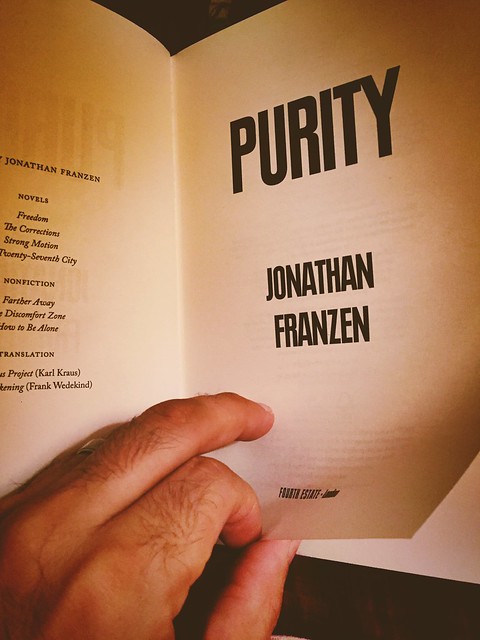
This post isn't meant to be an official review, because to be honest there are enough reviews of Purity on online, most of which are better written and more insightful than anything I could piece together here as my daughter plays with Lego.
Instead, I will try and weave together a few ideas that have been running rampant in my head for the last 563 pages.
Men and women are different, and although we may be trying to be what each gender needs the other to be, to make the other happy, we are often lost and confused and cause each other pain.
Franzen's characters, as per usual, are flawed and dysfunctional. To the point where they are depressed, homicidal and suicidal. I couldn't help but hate most of them for the same reasons I hate myself. The characters in Purity are all trying to be "good" but instead tend to find themselves wallowing in shame for acts they cannot seem to control.
They feel very human to me.
I am not sure that Franzen ever gets it right, as I don't think any writer ever can, when it comes to the "battle-of-sexes." I know many of my feminist female friends will cringe at the cliche characters of both genders, but what I respect is that he is trying to say something about what men and women want from each other.
And what he is saying is that we have no idea. Yes, we want equality and love and commitment, but what we tend to ignore is that all relationships are about a balancing of power, and this need for power, this equaling of the equation is not as simple as we hope. My showing the relationships between couples, men and men, women and women, mothers and sons, fathers and daughters, mothers and daughters and sons and fathers, Franzen shows us that balancing power in human relationships is a mess.
In the end, this book made me think. It frustrated the hell out of me. It entertained me and left me satisfied. What else can we expect from literature? I am not sure I would label it as a work of art, or that it has any long term staying power, at times it felt like a pulp novel focusing too much on the over-the-top plot, but this novel does what Franzen does best- this book forces us to look deeply into a mirror of our own (sexual, marital, parental, friendship and cyber) dysfunction and ask what the hell are we doing there? Who are we loving? Who are we hurting? How are we human?
If you hate Franzen then you will hate this book for sure, but if you can appreciate his work and his ambitious attempts to look at what it means to be a broken human being under a microscope for five hundred pages then give this one a read.
People, for some reason, either love or hate Jonathan Franzen. Yes, it is well known that he made waves when he called Edith Wharton ugly; he's known for hating the internet, and he gets a lot of shit for being a popular, domineering, overly-hyped white male. I get it, he is a lightening rod for many peoples' issues.
But what can I say? I like his work. I like his pretentious, bloated, trying-too-hard prose There is room for it in my literary diet and I enjoy the sensation of being stuffed when I consume one of his novels. Sure there is some indigestion with some of his lines, and most often his characters leave me a bit gassy, but over all, reading his work makes me feel like I went to a fancy restaurant where everyone involved was trying their best to give me a good experience. From sous chef to the sommelier, it's all hands on deck with a Franzen novel.
This post isn't meant to be an official review, because to be honest there are enough reviews of Purity on online, most of which are better written and more insightful than anything I could piece together here as my daughter plays with Lego.
Instead, I will try and weave together a few ideas that have been running rampant in my head for the last 563 pages.
Men and women are different, and although we may be trying to be what each gender needs the other to be, to make the other happy, we are often lost and confused and cause each other pain.
Franzen's characters, as per usual, are flawed and dysfunctional. To the point where they are depressed, homicidal and suicidal. I couldn't help but hate most of them for the same reasons I hate myself. The characters in Purity are all trying to be "good" but instead tend to find themselves wallowing in shame for acts they cannot seem to control.
They feel very human to me.
I am not sure that Franzen ever gets it right, as I don't think any writer ever can, when it comes to the "battle-of-sexes." I know many of my feminist female friends will cringe at the cliche characters of both genders, but what I respect is that he is trying to say something about what men and women want from each other.
And what he is saying is that we have no idea. Yes, we want equality and love and commitment, but what we tend to ignore is that all relationships are about a balancing of power, and this need for power, this equaling of the equation is not as simple as we hope. My showing the relationships between couples, men and men, women and women, mothers and sons, fathers and daughters, mothers and daughters and sons and fathers, Franzen shows us that balancing power in human relationships is a mess.
In the end, this book made me think. It frustrated the hell out of me. It entertained me and left me satisfied. What else can we expect from literature? I am not sure I would label it as a work of art, or that it has any long term staying power, at times it felt like a pulp novel focusing too much on the over-the-top plot, but this novel does what Franzen does best- this book forces us to look deeply into a mirror of our own (sexual, marital, parental, friendship and cyber) dysfunction and ask what the hell are we doing there? Who are we loving? Who are we hurting? How are we human?
If you hate Franzen then you will hate this book for sure, but if you can appreciate his work and his ambitious attempts to look at what it means to be a broken human being under a microscope for five hundred pages then give this one a read.


