friday night
one o’ six am
forty seven years old,
half glass of pinot
a stale brownie
and phoebe bridges
on the ear goggles.
finished clean up
after pam and martin left,
washing dishes and packing up
the left over cheese,
listening to pink floyd and bob marley
brain damage and bablyon system.
before they came,
i brewed raspberry syrup and
squeezed fresh lemon juice,
ordered pizza, laid out the cheese plate
with home made pickles,
made a clover cocktail, a mojito,
a gin and tonic, a manhattan, and a few
brooklyns. we drained three bottles of
cabernet sauvignon, ordered pizza
and listened to an acoustic
indie spotify playlist.
the conversation settled into familiar pockets:
children, concerts we went to, television shows we’re watching
the authenticity of reading books versus listening to them.
earlier, i watched a video from a nineteen ninety seven.
a road trip we took across the country. i’d found an
old vhs tape a few days ago and transferred it to mp4.
in it i am young, skinny and jittery. ears pierced,
a few fewer tattoos. anxious. full of life.
it’s a miracle how we live in the past, this moment and
in awe of who we might become in the threatening future.
there is no way that boy in nineteen ninety seven
could have imagined this man, constructing this poem
twenty years later- fat in belly, white in hair and beard.
how will we look at sixty seven?
how will the promises weather the storms?
i don’t want
this night to end,
but tomorrow
is closer than it looks
and these days
there is little need
for such reckless chaos.

Showing posts with label bobmarley. Show all posts
Showing posts with label bobmarley. Show all posts
July 31, 2021
211/365


February 24, 2009
Bars Could Not Hold Me
I will be the first to admit that I have completely dropped the ball on the Bob Marley project. I wanted it to be an exhaustive, reflective overview of every aspect of the book Catch a Fire, but what ended up happening was the book ran away from me.
Every night, I would read fifty pages or more and the reflections took a back seat. I have always been hyperbolic, so what I am about to say is nothing new, but I will say it anyway:
Catch A Fire is one of the most important books of the twentieth century. It is a must read not only for music connoisseur, while the extensive exploration of reggae is second to none, it is how this book contextualizes the socio-political/economic and historic events that gave birth to yet another music genre rooted in the ghetto and suffering and oppression that make this book mandatory reading. A hybrid history text, biography, and blueprint of the music industry, Catch a Fire demands to be read by anyone with an interest in humanity.
I am only sorry I did not write the posts, in which I compare the similarities between Bob Marley and Tupac Shakur:

 But stay tuned, I am not done with my investigation yet. I hope to write more posts under the Bob Marley tag in the coming weeks. I feel saddened that this book is finished. I am excited with the bonds I have made with Marley's story.
I will leave you with my favorite song. I have written about Babylon System before, but this song more than any other epitomizes the power and influence Bob Marley has had on the world. His message cannot be anymore obvious:
We refuse to be
What you wanted us to be;
We are what we are:
That's the way it's going to be. If you don't know!
You can't educate I
For no equal opportunity:
Talkin' 'bout my freedom,
People freedom and liberty!
Yeah, we've been trodding on the winepress much too long:
Rebel, rebel!
Yes, we've been trodding on the winepress much too long:
Rebel, rebel!
Babylon system is the vampire, yea!
Suckin' the children day by day, yeah!
Me say: de Babylon system is the vampire, falling empire,
Suckin' the blood of the sufferers, yea-ea-ea-ea-e-ah!
Building church and university, wo-o-ooh, yeah! -
Deceiving the people continually, yea-ea!
Me say them graduatin' thieves and murderers;
Look out now: they suckin' the blood of the sufferers
Yea-ea-ea!
Tell the children the truth;
Tell the children the truth;
Tell the children the truth right now!
Come on and tell the children the truth;
Tell the children the truth;
Tell the children the truth;
Tell the children the truth;
Come on and tell the children the truth.
'Cause - 'cause we've been trodding on ya winepress much too long:
Rebel, rebel!
And we've been taken for granted much too long:
Rebel, rebel now!
Trodding on the winepress
got to rebel, y'all!
We've been trodding on the winepress much too long - ye-e-ah!
Yea-e-ah! Yeah! Yeah!
From the very day we left the shores
Of our Father's land
We've been trampled on,
Oh now! (we've been oppressed, yeah!) Lord, Lord, go to ..
Next book in my cue is Sam Harris’ Letter to a Christian Nation; perhaps I will be better at documenting my thoughts on that book.
Every night, I would read fifty pages or more and the reflections took a back seat. I have always been hyperbolic, so what I am about to say is nothing new, but I will say it anyway:
Catch A Fire is one of the most important books of the twentieth century. It is a must read not only for music connoisseur, while the extensive exploration of reggae is second to none, it is how this book contextualizes the socio-political/economic and historic events that gave birth to yet another music genre rooted in the ghetto and suffering and oppression that make this book mandatory reading. A hybrid history text, biography, and blueprint of the music industry, Catch a Fire demands to be read by anyone with an interest in humanity.
I am only sorry I did not write the posts, in which I compare the similarities between Bob Marley and Tupac Shakur:

 But stay tuned, I am not done with my investigation yet. I hope to write more posts under the Bob Marley tag in the coming weeks. I feel saddened that this book is finished. I am excited with the bonds I have made with Marley's story.
I will leave you with my favorite song. I have written about Babylon System before, but this song more than any other epitomizes the power and influence Bob Marley has had on the world. His message cannot be anymore obvious:
Tell the children the truth and REBEL, REBEL, REBEL!
We refuse to be
What you wanted us to be;
We are what we are:
That's the way it's going to be. If you don't know!
You can't educate I
For no equal opportunity:
Talkin' 'bout my freedom,
People freedom and liberty!
Yeah, we've been trodding on the winepress much too long:
Rebel, rebel!
Yes, we've been trodding on the winepress much too long:
Rebel, rebel!
Babylon system is the vampire, yea!
Suckin' the children day by day, yeah!
Me say: de Babylon system is the vampire, falling empire,
Suckin' the blood of the sufferers, yea-ea-ea-ea-e-ah!
Building church and university, wo-o-ooh, yeah! -
Deceiving the people continually, yea-ea!
Me say them graduatin' thieves and murderers;
Look out now: they suckin' the blood of the sufferers
Yea-ea-ea!
Tell the children the truth;
Tell the children the truth;
Tell the children the truth right now!
Come on and tell the children the truth;
Tell the children the truth;
Tell the children the truth;
Tell the children the truth;
Come on and tell the children the truth.
'Cause - 'cause we've been trodding on ya winepress much too long:
Rebel, rebel!
And we've been taken for granted much too long:
Rebel, rebel now!
Trodding on the winepress
got to rebel, y'all!
We've been trodding on the winepress much too long - ye-e-ah!
Yea-e-ah! Yeah! Yeah!
From the very day we left the shores
Of our Father's land
We've been trampled on,
Oh now! (we've been oppressed, yeah!) Lord, Lord, go to ..
Next book in my cue is Sam Harris’ Letter to a Christian Nation; perhaps I will be better at documenting my thoughts on that book.
February 12, 2009
Craven Choke Puppy
Beginning with chapter three, White shifts form the macro-world of history and narrows his pen in on a small one room shack in Nine Miles, a small village in rural Jamaica. (Xaymca, an Arawak Indian word meaning “Land of Springs” after the 134 rivers found on the island.) Where a seventeen-year-old “Ciddy” Marley is about to give birth to Robert “Nesta” Marley. We learn that Ciddy was impregnated by a Norval Marley, a white businessman from Kingston who claimed to love her, but abandon her and their son as soon as Nesta was born.

White paints a fascinating picture of Nesta’s early life as a precocious and mischievous fortuneteller growing up in a tiny pastoral parish. Throughout Nine Miles, Nesta is seen as an intelligent numinous child, sensitive, quiet and brooding. We learn of his early childhood education, listening to stories from the elders. Stories like the one about Prester John and the Cromanty of the Akan tribes, alongside stories of the Bible about, “ Jacob who fell asleep on a rock and dreamt of the dead ascending difficult mountainsides and sheer ladder into Heaven, weighed down by all their worldly possessions and the wages of sin, and how the greediest would lose their footing or tire and swoon because of their onerous burdens, tumbling into the Pit of Fire.”
It is easy to see how this early stage in Nesta’s life fueled much of the themes in his music and helped create the global spokesman for the oppressed.

Nesta and Ciddy live in Nine Mile until he is four years old, at which point Norval asks that Robert be brought to Kingston for a better education. Once there, Nesta is again abandon to the care of a stranger for almost a year. Ciddy has no idea where he is until, by chance a relative spots Nesta in a Trenchtown “yard.”
 Reunited with his mother, Ciddy decides to make a change and move both of them to Kingston. It is hard when looking at this picture:
 to imagine the scared single mom trying to make it in the rough Trenchtown ghetto, but as I am sure I will see as I continue to read, she does, and from these streets and rural villages, Nesta becomes Bob.
I was especially struck by the use of elegant language and intricate descriptions in these early chapters. This book is a pleasure to read as the prose flows seamlessly. Below you will find a few choice quotes as well as some language discoveries that shed light on song lyrics:

Understanding a man’s early life is crucial to completing the puzzle of his destiny. Although dirt-poor, both in rural and urban environments abandon by his father, treated suspiciously by his townsmen for his strange mysticism and bi-culturalism, Marley was deeply loved by his family.
I think back to my own first four years, and while I do not remember much of it, I have been told that I lived my share of turmoil- a nation in revolution, early martial strife, exile and emigration to a new land, and money problems also shaped my life, but like Marley the devotion of a loving mother also made me the man I am today.
My appreciation for Marley's music is rapidly grown more than I thought possible. I can't wait to see where this path will lead.

White paints a fascinating picture of Nesta’s early life as a precocious and mischievous fortuneteller growing up in a tiny pastoral parish. Throughout Nine Miles, Nesta is seen as an intelligent numinous child, sensitive, quiet and brooding. We learn of his early childhood education, listening to stories from the elders. Stories like the one about Prester John and the Cromanty of the Akan tribes, alongside stories of the Bible about, “ Jacob who fell asleep on a rock and dreamt of the dead ascending difficult mountainsides and sheer ladder into Heaven, weighed down by all their worldly possessions and the wages of sin, and how the greediest would lose their footing or tire and swoon because of their onerous burdens, tumbling into the Pit of Fire.”
It is easy to see how this early stage in Nesta’s life fueled much of the themes in his music and helped create the global spokesman for the oppressed.

Nesta and Ciddy live in Nine Mile until he is four years old, at which point Norval asks that Robert be brought to Kingston for a better education. Once there, Nesta is again abandon to the care of a stranger for almost a year. Ciddy has no idea where he is until, by chance a relative spots Nesta in a Trenchtown “yard.”
 Reunited with his mother, Ciddy decides to make a change and move both of them to Kingston. It is hard when looking at this picture:
 to imagine the scared single mom trying to make it in the rough Trenchtown ghetto, but as I am sure I will see as I continue to read, she does, and from these streets and rural villages, Nesta becomes Bob.
I was especially struck by the use of elegant language and intricate descriptions in these early chapters. This book is a pleasure to read as the prose flows seamlessly. Below you will find a few choice quotes as well as some language discoveries that shed light on song lyrics:
“City folk play rough,” Omeriah (Marley’s grandfather) liked to say “cause dem never learned to play.”

Intermittent gaps in the pandemonium revealed a curb-level landscape of garbage and filth; smashed bottles, flattened tin cans, animal and human waste, yellowed newspapers, fish and fowl bones and oily rags intermingled with all manner of vegetable husks, crushed grocery cartons, shattered household articles and dismembered domestic conveniences, the latter ranging from the scorched spinal column of a dressmaker’s dummy to the shell of a radio set and the rusty rib cage of a tattered bed.“Nuh eat suh quickish! A nervous Ciddy warned. “Craven (craving, gluttony) a go choke puppy!”
Abandon automobiles, stripped clean of anything remotely desirable, formed a broken line parallel to the bumper-to-bumper rows of whole, humming cars that were attempting in vain to escape this gutted graveyard. There was just no way to proceed, and apparently nowhere in particular to go. Nesta was accustomed to seeing ancient but doggedly maintained structures in the country, but most of these cast-concrete hovels were sinister bunkers into which no light intruded, and the eyes that blinked form the dusky doorways were anything but inviting.
So you want all for yourself alone
And you don't think about the other man
Let me tell you my friend if you gonna live this life
It's not good for you to build strife
Understanding a man’s early life is crucial to completing the puzzle of his destiny. Although dirt-poor, both in rural and urban environments abandon by his father, treated suspiciously by his townsmen for his strange mysticism and bi-culturalism, Marley was deeply loved by his family.
I think back to my own first four years, and while I do not remember much of it, I have been told that I lived my share of turmoil- a nation in revolution, early martial strife, exile and emigration to a new land, and money problems also shaped my life, but like Marley the devotion of a loving mother also made me the man I am today.
My appreciation for Marley's music is rapidly grown more than I thought possible. I can't wait to see where this path will lead.
February 11, 2009
Kingdom Come
Doing research and absorbing information in the 21st century is both exciting and overwhelming. Every piece of the puzzle leads you to another piece, until you are left needing to see the entire picture to make sense of any of it.
I started by reading Catch a Fire, the Bob Marley biography, and already I am being buried under the information I am finding. One can quickly become besieged if the right choices are not made. The question becomes not how many facts or opinions one can find, but what is done with the newly found knowledge, what meaning is constructed.
This post will cover chapter two from the book, Kingdom Come, which covers the life of the emperor of Halie Selassie. You can easily read his wikipedia article yourself and get the basic idea of his life story. You can even read the chapter here on Google books, so there is no point in me outlining the details of his life.
I want to talk more about the information trail. After reading up on Selassie a bit, I was led to King Solomon. Apparently around 900 B.C Solomon fathered a son through Queen Sheba, the queen of Ethiopia. The story goes that Selassie is a direct blood descendent of King Solomon, hence the belief of many Rasta that Selassie is a prophet and god incarnate.

I am not here to list a series of facts on Selassie or Solomon. You can watch your own videos here or here and here.
I see the role of the blogger, or at least this blogger, is to take the information analyze and synthesize it, then try to express some new insight on the topic, if insight is beyond reach then perhaps at least some reflection and expression of feelings.
Long story short, I was being buried by the Selassie information and since it is not the main source of my inquiry, albeit a very important facet of my search, I decided to try and collate as much data as I could and sift through the results.
The first thing I did was create a Wordle of his wikipedia page:
 Imperial
I found it fascinating that this symbol of what is often though of a loving peaceful religion, Rastafarianism, was really nothing more than a conniving Machiavellian power broker. I was hoping that the Worlde would provide a more balanced, loving picture of the Emperor, one that was more congruous with the Rasta image, but alas the words were not encouraging. What’s more the very man who had set up Selassie as the Rasta savior, Garvey, would go on to renounce Selassie as a coward years later. Furthermore, it curious that a religion and a political movement as ethnocentric as Rastafarianism, with it’s return to African pride, would base so much of its belief system on a religion that began not in Africa but the Middle East, a religion that has done nothing to ever promote or aid Africa in anyway, except to treat Africans as inferiors and slaves.
So why would Jamaican descendents of slaves worship an heir of an old Jewish king? Why would they choose to re-write a Judeo-Christian text, rather than stick to more African mysticism? Why did Bob Marley, who seemed to have a full understanding of geo-political affairs especially in regards to Africa, colonialism, and the African Diaspora experience choose to follow a belief system that made a god of Selassie, a man that as far as I can see did not promote peace, love, or understanding.
In addition to wikipedia distillation, I decide to find some pictures of the man and create a collage. I am not sure what effect I was hoping this newly created image would have, but I feel it is important that through research it is important to create something. I wouldn’t necessarily call creating a collage of images form google art, but for my time frame and interest in Selassie , it is all I could do. Perhaps the final product for the Marley project will incorporate the things I learned about Selassie.

I will be the first to admit that I have made some superficial observations about a man I know little about. I hope that if there is anyone out there who knows more, or can show another side of Selassi than you will comment on this post so we can learn from each other.
I was just struck by this quote as a picture of Selassie's priorities:
 Makes you wonder what Peter Tosh the rest of The Wailers were thinking when they wrote Get Up Stand Up:
I started by reading Catch a Fire, the Bob Marley biography, and already I am being buried under the information I am finding. One can quickly become besieged if the right choices are not made. The question becomes not how many facts or opinions one can find, but what is done with the newly found knowledge, what meaning is constructed.
This post will cover chapter two from the book, Kingdom Come, which covers the life of the emperor of Halie Selassie. You can easily read his wikipedia article yourself and get the basic idea of his life story. You can even read the chapter here on Google books, so there is no point in me outlining the details of his life.
I want to talk more about the information trail. After reading up on Selassie a bit, I was led to King Solomon. Apparently around 900 B.C Solomon fathered a son through Queen Sheba, the queen of Ethiopia. The story goes that Selassie is a direct blood descendent of King Solomon, hence the belief of many Rasta that Selassie is a prophet and god incarnate.

I am not here to list a series of facts on Selassie or Solomon. You can watch your own videos here or here and here.
I see the role of the blogger, or at least this blogger, is to take the information analyze and synthesize it, then try to express some new insight on the topic, if insight is beyond reach then perhaps at least some reflection and expression of feelings.
Long story short, I was being buried by the Selassie information and since it is not the main source of my inquiry, albeit a very important facet of my search, I decided to try and collate as much data as I could and sift through the results.
The first thing I did was create a Wordle of his wikipedia page:
 Imperial
Emperor
United
Nation
State
World
War
Death
Church
United
Nation
State
World
War
Death
Church
I found it fascinating that this symbol of what is often though of a loving peaceful religion, Rastafarianism, was really nothing more than a conniving Machiavellian power broker. I was hoping that the Worlde would provide a more balanced, loving picture of the Emperor, one that was more congruous with the Rasta image, but alas the words were not encouraging. What’s more the very man who had set up Selassie as the Rasta savior, Garvey, would go on to renounce Selassie as a coward years later. Furthermore, it curious that a religion and a political movement as ethnocentric as Rastafarianism, with it’s return to African pride, would base so much of its belief system on a religion that began not in Africa but the Middle East, a religion that has done nothing to ever promote or aid Africa in anyway, except to treat Africans as inferiors and slaves.
So why would Jamaican descendents of slaves worship an heir of an old Jewish king? Why would they choose to re-write a Judeo-Christian text, rather than stick to more African mysticism? Why did Bob Marley, who seemed to have a full understanding of geo-political affairs especially in regards to Africa, colonialism, and the African Diaspora experience choose to follow a belief system that made a god of Selassie, a man that as far as I can see did not promote peace, love, or understanding.
In addition to wikipedia distillation, I decide to find some pictures of the man and create a collage. I am not sure what effect I was hoping this newly created image would have, but I feel it is important that through research it is important to create something. I wouldn’t necessarily call creating a collage of images form google art, but for my time frame and interest in Selassie , it is all I could do. Perhaps the final product for the Marley project will incorporate the things I learned about Selassie.

I will be the first to admit that I have made some superficial observations about a man I know little about. I hope that if there is anyone out there who knows more, or can show another side of Selassi than you will comment on this post so we can learn from each other.
I was just struck by this quote as a picture of Selassie's priorities:
 Makes you wonder what Peter Tosh the rest of The Wailers were thinking when they wrote Get Up Stand Up:
We sick an tired of-a your ism-skism game -Did they not worship a living man?
Dyin n goin to heaven in-a jesus name, lord.
We know when we understand:
Almighty God is a living man.
You can fool some people sometimes,
But you cant fool all the people all the time.
February 10, 2009
Duppy Conqueror
I was a bit disappointed by White’s description of Halie Selassie. I felt the Garvey account was enough to put the birth of Rastafarianism into context, but the curt paragraph on Selassie left me wanting more. Little did I know that the next chapter would be dedicated exclusively to Selassie. I will write on that in a subsequent post, but here I wanted to highlight a few passages from Riddim Track, the first chapter of the book.
The chapter ends with an introduction to Marley’s influence. White paints the image of the man with very broad-brush strokes. It is obvious to me now, that White likes to initially smear his canvas with the big picture, only to go back and carefully paint the minutest details.
We are led to understand that Marley and the Wailers were more than musicians. They were shamans and storytellers who played a pivotal part in not only keeping a history alive, but also in maintaining and fostering its growth:
 The Rastas listening to Marley’s music were not merely bobbing their heads to One Love like their Caucasian brothers; this music was a form of spiritual, cultural, and holy communion. It is that duel level of appreciation that makes the music so universal.
 I am so glad that i am beginning to better understand his music on multiple levels. A quick example: I now know the meaning of the word Duppy, as in the song “Duppy Conqueror.” Duppies are spirits of the dead. I always thought he was saying dumpy conqueror, and honestly I was not too clear what he meant, but now I know that he was using the traditional Jamaican street saw used when defying a bully: “If yuh bullbacker, me duppy conqueror.” This was a song he penned after being released from a minor ganja arrest in Kingston.

Read a preview of the book here at Google Book.
What is your understanding of the music? Have you any insights into the folklore?
The chapter ends with an introduction to Marley’s influence. White paints the image of the man with very broad-brush strokes. It is obvious to me now, that White likes to initially smear his canvas with the big picture, only to go back and carefully paint the minutest details.
We are led to understand that Marley and the Wailers were more than musicians. They were shamans and storytellers who played a pivotal part in not only keeping a history alive, but also in maintaining and fostering its growth:
 The Rastas listening to Marley’s music were not merely bobbing their heads to One Love like their Caucasian brothers; this music was a form of spiritual, cultural, and holy communion. It is that duel level of appreciation that makes the music so universal.
 I am so glad that i am beginning to better understand his music on multiple levels. A quick example: I now know the meaning of the word Duppy, as in the song “Duppy Conqueror.” Duppies are spirits of the dead. I always thought he was saying dumpy conqueror, and honestly I was not too clear what he meant, but now I know that he was using the traditional Jamaican street saw used when defying a bully: “If yuh bullbacker, me duppy conqueror.” This was a song he penned after being released from a minor ganja arrest in Kingston.
Read a preview of the book here at Google Book.
What is your understanding of the music? Have you any insights into the folklore?
February 8, 2009
Look to Africa
The book, Catch A Fire, begins with Marley in the early eighties at a concert in Zimbabwe dismayed by the true nature of independence there. He is playing a show where people are forcing their way over barricades to enter the sold-out stadium. His toe is throbbing do to the cancer that is spreading throughout his body, because he refuses to have his toe amputated.
We learn that the roots of this “millenarian-messianic cult” are planted in the “back-to-Africa” teachings of Marcus Garvey. After watching some clips from a documentary on Garvey on Youtube, I found a strange connection between Garvey’s militant philosophies and J. Edgar Hoover. Not wanting to get bogged down in Garvey’ story I only watch part of the this film, but hope to watch the rest later.
Garvey’s statement “look to Africa” for the crowning of the black king is customarily cited as the spark that galvanized the Garveyites into founding the sect that came to be known as Rastafarians so called because Ras Tafari was Selassie’s given name- Selassie being the anointed king of Ethiopia.
While some state that “Rasta starts with Garvey,” others such as historian Robert A. Hill of UCLA refute this claim, saying that there is little evidence that Garvey ever made such statements about divine African kings. There is actually this article Garvey wrote denouncing Selassie.
 It’s hard to tell whether Garvey was a legitimate leader or simply an egoist prone to ornate displays of showmanship. I will leave you to read more on him yourself, but for now it is important to note that he played a crucial role in the development of both Rastafarianism and eventually the music of Bob Marley. There is a further ironic connection when we learn that the CIA and FBI would later monitor Marley’s activities much like they did Garvey before arresting him and deporting him back to his native home, Jamaica.
Another interesting item I discovered was the Holy Piby. Known as the “black man’s Bible", it was complied by Robert Athlyi Rogers of Anguilla in 1913 to 1917. Once again, I will leave you to read the text in its entirety here, but it is important to mention because of its profound influence on rural Jamaican culture, the rise of the Rastafarian movement, and eventually on Marley’s worldview and music.
Early in the reading of this book, I feel that if I want to truly gain a better understanding of the religious significance of Marley’s music, I must look deeper into these early pioneers and their work. I hope to revisit this early history in the coming weeks. This is the part of the project where I would welcome any insight or expertise. What do you know about the Holy Piby, Marcus Garvey, or Selassie?
 Believe it or not this entire history lesson is packed in the first twenty pages of the book. This will be a very in-depth and long process, but I am very excited by it. Please click on the tag bobmarley in the cloud to follow all posts in this thread.
Rasta no abide amputation. I and I (which I learned means me and my brethren) don’t allow a mon ta be dismantled.His eyes are red from the tear gas being used to disperse the crowd just beyond the walls. While the first few paragraphs leave us in this state of chaos, White flashes back and begins his session on the history of Rastafarianism.
We learn that the roots of this “millenarian-messianic cult” are planted in the “back-to-Africa” teachings of Marcus Garvey. After watching some clips from a documentary on Garvey on Youtube, I found a strange connection between Garvey’s militant philosophies and J. Edgar Hoover. Not wanting to get bogged down in Garvey’ story I only watch part of the this film, but hope to watch the rest later.
Garvey’s statement “look to Africa” for the crowning of the black king is customarily cited as the spark that galvanized the Garveyites into founding the sect that came to be known as Rastafarians so called because Ras Tafari was Selassie’s given name- Selassie being the anointed king of Ethiopia.
While some state that “Rasta starts with Garvey,” others such as historian Robert A. Hill of UCLA refute this claim, saying that there is little evidence that Garvey ever made such statements about divine African kings. There is actually this article Garvey wrote denouncing Selassie.
 It’s hard to tell whether Garvey was a legitimate leader or simply an egoist prone to ornate displays of showmanship. I will leave you to read more on him yourself, but for now it is important to note that he played a crucial role in the development of both Rastafarianism and eventually the music of Bob Marley. There is a further ironic connection when we learn that the CIA and FBI would later monitor Marley’s activities much like they did Garvey before arresting him and deporting him back to his native home, Jamaica.
Another interesting item I discovered was the Holy Piby. Known as the “black man’s Bible", it was complied by Robert Athlyi Rogers of Anguilla in 1913 to 1917. Once again, I will leave you to read the text in its entirety here, but it is important to mention because of its profound influence on rural Jamaican culture, the rise of the Rastafarian movement, and eventually on Marley’s worldview and music.
Meeting immediately with much persecution from the Fundamentalists, Revivalist and more conventional Christian church leaders for the adherence to this occult Bible, early Rastafarian leaders fled into the bush country of the St. Thomas parish, in Eastern Jamaica, and it was there that the seeds of Rastafarianism were planted.While I find much of this early history a bit too doused in Judeo-Christian mythology for my taste- Holy Piby, Marcus Garvey, and Salessie sound to me like a bizarre myth, but I think it is important to understand how influential the idea of an exiled African Diaspora was to Marley’s music.
Early in the reading of this book, I feel that if I want to truly gain a better understanding of the religious significance of Marley’s music, I must look deeper into these early pioneers and their work. I hope to revisit this early history in the coming weeks. This is the part of the project where I would welcome any insight or expertise. What do you know about the Holy Piby, Marcus Garvey, or Selassie?
 Believe it or not this entire history lesson is packed in the first twenty pages of the book. This will be a very in-depth and long process, but I am very excited by it. Please click on the tag bobmarley in the cloud to follow all posts in this thread.
February 7, 2009
Context
It is easy to deride Bob Marley and his music as trite, naïve, idealistic college music. The image of a dreaded white guy blasting his copy of Legend in a haze of incense and Marijuana smoke, or worse, playing a cover of Redemption Song, while a patchouli soaked crowd sways back and forth, flashing peace signs, chanting one love is a disturbing scene even to me.
I hope that this project helps people see Marley as more than a legalize Marijuana peacenik poster boy. I have always held a special place in my heart for Marley, but a few months ago I realized that I wanted to know more about him. My surface level knowledge of his life was not enough to help me put his music into the social historical context I need to create meaning in my world.
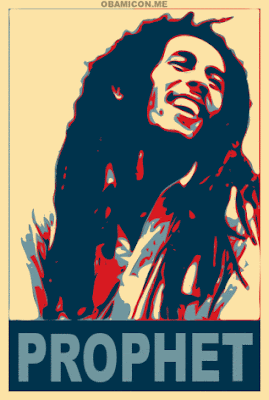 I needed to know more about the world that had helped give birth and foster this modern day prophet. My relationship started in seventh grade and my copy of Rebel Music. It was the first Marley album I owned. Although I was listening to intense political discussions at my father’s dinner parties, there remained a huge gap between what I was learning at home and at school. The play it safe “social studies” curriculum was too busy brainwashing me in civic mindedness to focus on the issues being raised by Marley in Rebel Music. Each song is a lesson in modern day political hypocrisy and social activism:
1. Rebel Music (3 O'Clock Roadblock)
2. So Much Trouble in the World
3. Them Belly Full (But We Hungry)
4. Rat Race
5. War/No More Trouble
6. Roots, Rock, Reggae
7. Slave Driver
8. Ride Natty Ride
9. Crazy Baldhead
10. Get up, Stand Up
 I will spend the next few weeks exploring each song in depth, but I still remember the excitement I felt listening to these rebellious anthems. One need not hear more than,
Or
While I enjoyed the optimism of favorite Marley sing-a-longs, it was in his politics that I truly connected with the man.
Ever since then, I have been a regular listener to his music. I have taught his songs to my students in Mozambique, the Bronx, and Qatar. I will write more on these experiences in future posts. I wanted to start this project explaining where I am coming from.
I earnestly respect Marley. I see him as more than a musician or even social activist. Although I am not religious, I see Marley as an incarnation of the same spirit of peace and freedom of which I include: The Buddha, Jesus Christ, Gandhi, and many others.
In his book White mentions how people were intrigued and mesmerized by
So what is your starting point for Marley? Where did you first hear his music? What struck you about him first? Are you still listening to him or was a passing college phase? Perhaps you have never listening to Marley, what are your thoughts?
I hope that this project helps people see Marley as more than a legalize Marijuana peacenik poster boy. I have always held a special place in my heart for Marley, but a few months ago I realized that I wanted to know more about him. My surface level knowledge of his life was not enough to help me put his music into the social historical context I need to create meaning in my world.
I needed to know more about the world that had helped give birth and foster this modern day prophet. My relationship started in seventh grade and my copy of Rebel Music. It was the first Marley album I owned. Although I was listening to intense political discussions at my father’s dinner parties, there remained a huge gap between what I was learning at home and at school. The play it safe “social studies” curriculum was too busy brainwashing me in civic mindedness to focus on the issues being raised by Marley in Rebel Music. Each song is a lesson in modern day political hypocrisy and social activism:1. Rebel Music (3 O'Clock Roadblock)
2. So Much Trouble in the World
3. Them Belly Full (But We Hungry)
4. Rat Race
5. War/No More Trouble
6. Roots, Rock, Reggae
7. Slave Driver
8. Ride Natty Ride
9. Crazy Baldhead
10. Get up, Stand Up
 I will spend the next few weeks exploring each song in depth, but I still remember the excitement I felt listening to these rebellious anthems. One need not hear more than,
A hungry man is an angry manto understand the nature of crime.
Or
Until the philosophy which holds one raceto understand political disasters like the modern day Gazan war.
Superior and another inferior
Is finally and permanently discredited and abandoned
Everywhere is war, me say war
While I enjoyed the optimism of favorite Marley sing-a-longs, it was in his politics that I truly connected with the man.
Ever since then, I have been a regular listener to his music. I have taught his songs to my students in Mozambique, the Bronx, and Qatar. I will write more on these experiences in future posts. I wanted to start this project explaining where I am coming from.
I earnestly respect Marley. I see him as more than a musician or even social activist. Although I am not religious, I see Marley as an incarnation of the same spirit of peace and freedom of which I include: The Buddha, Jesus Christ, Gandhi, and many others.
In his book White mentions how people were intrigued and mesmerized by
the ethno-political thrust of his snarling reggae anthems, and the inside-out time signatures that kept them pulsating.I am no different. I have never listened to much Reggae beyond Marley, so I may not be the best judge, but I see Marley’s music beyond Reggae. With elements of Motown, soul, and rock, Bob Marley is beyond genres. He simply delivers music at its purest and most honest level. But more of that to come.
So what is your starting point for Marley? Where did you first hear his music? What struck you about him first? Are you still listening to him or was a passing college phase? Perhaps you have never listening to Marley, what are your thoughts?
Catch A Fire
I have a new project and want to invite you to come learn with me. I use the term “you” loosely because I am not sure who the audience of this post may be. I am trying to recruit you- You may be a close personal friend, or maybe an acquaintance from high school that I have spoken to in years, you may be a current colleague, all of whom I have culled from Facebook. You may be a regular reader of Intrepid Flame or a first time visitor brought here by a random Google search, or I may have asked you to join me from Twitter; regardless of how you are connected to me, I want to use our networked connection to learn, share, construct meaning, and explore the world of Bob Marley.

Before I continue let me elucidate a few points about how I read, learn, and express my knowledge. I have been mired in a non-fiction pile of books for almost two years. I can’t remember the last novel I read. As I read these books, I often find myself researching tangential topics on the Internet and mentally planning epic blog posts recanting all of my newfound knowledge and ideas. The problem is that these posts are rarely written, because I wait until I finish the book to scribe my thoughts, and I am often to impatient and need to jump to the next book in my cue, to spend enough time reflecting on what I have read and learned.
For this project, I want to try something new. I want to try and write a few paragraphs after every reading session, which is usually at least twenty or so pages a day. While reading, I always highlight the text, but seldom do nothing more that skim my annotations upon completion of any given book. For this project, I want to insert these highlighted passages into blog posts and reflect on what the passages me to me. I want to invite you to share your thoughts and insights, either on the quotes themselves, or on my thoughts.
Besides textual reflective blog posts, I would like to utilize as many types of media and web tools as possible to really flush out my connection to this topic. I hope to share videos, songs, while also inviting you will join me in creating podcasts or other original work loosely tied to Marley’s legacy.
In short, I want us, who ever you may be to learn as much as we can about Bob Marley and share what we find with the world in an effort to increase our understanding of not only Marley, but Rastafarianism, Jamaican history, and the role of reggae music on Pan-Africanism and modern day social/racial issues.
Only you can choose your level of involvement in this project. I hope that at the least you will read the posts and leave occasional comments, but really, I hope I can find one or two people to really take this journey with me.
Let me share with you my packing list: So far I have started reading Catch A Fire by Timothy White. My preliminary researched proved that this is the definitive book on Marley:
I will tag and categorize every post as BobMarley, so please stop by as often as you can and participate at what ever level you feel comfortable. This is only the beginning, so please follow the tags and lets get started! Leave a comment if you have any ideas of how you can be involved with this project.

Before I continue let me elucidate a few points about how I read, learn, and express my knowledge. I have been mired in a non-fiction pile of books for almost two years. I can’t remember the last novel I read. As I read these books, I often find myself researching tangential topics on the Internet and mentally planning epic blog posts recanting all of my newfound knowledge and ideas. The problem is that these posts are rarely written, because I wait until I finish the book to scribe my thoughts, and I am often to impatient and need to jump to the next book in my cue, to spend enough time reflecting on what I have read and learned.
For this project, I want to try something new. I want to try and write a few paragraphs after every reading session, which is usually at least twenty or so pages a day. While reading, I always highlight the text, but seldom do nothing more that skim my annotations upon completion of any given book. For this project, I want to insert these highlighted passages into blog posts and reflect on what the passages me to me. I want to invite you to share your thoughts and insights, either on the quotes themselves, or on my thoughts.
Besides textual reflective blog posts, I would like to utilize as many types of media and web tools as possible to really flush out my connection to this topic. I hope to share videos, songs, while also inviting you will join me in creating podcasts or other original work loosely tied to Marley’s legacy.
In short, I want us, who ever you may be to learn as much as we can about Bob Marley and share what we find with the world in an effort to increase our understanding of not only Marley, but Rastafarianism, Jamaican history, and the role of reggae music on Pan-Africanism and modern day social/racial issues.
Only you can choose your level of involvement in this project. I hope that at the least you will read the posts and leave occasional comments, but really, I hope I can find one or two people to really take this journey with me.
Let me share with you my packing list: So far I have started reading Catch A Fire by Timothy White. My preliminary researched proved that this is the definitive book on Marley:
The information is based on interviews I conducted with Bob (I spoke with him on some two dozen separate occasions.) between 1975 and 1981, plus interviews I conducted over the years with other members of the Wailers, the band’s producers, additional back up musicians, various other co-workers, record company executives, body guard and roadies, as well as family and friends. Other sources included prominent figures in Jamaican recording industry, island politicians, Rasta elders, country soothsayers, backwoods preachers, social workers, sociologist, ghetto thugs and bush nannies.I think it is safe to say this is a good place to start any journey into the Marley myth. The language of the text flows effortlessly, and creates a beautiful landscape on which to absorb the history. Even the preface and introduction alert the reader of the magnitude that the 400 plus page book is about to deliver. I have not been this excited to read a book in a long time:
Tim has said that his book is about “personal destiny.” He believed that you are never handed your destiny but that you have to chase it like a moving train; you run until your legs and lungs ache, and if you are extremely lucky you might catch it, thereby living the life intended of you. He loved Marley for not only boarding that rain but also for becoming its engineer.In addition to the text, I have downloaded every studio-released album, in addition to a few live shows. I have also ordered Catch a Fire, a documentary on Marley’s life. I want to immerse myself into this world for the duration of the time I am reading this book.
I will tag and categorize every post as BobMarley, so please stop by as often as you can and participate at what ever level you feel comfortable. This is only the beginning, so please follow the tags and lets get started! Leave a comment if you have any ideas of how you can be involved with this project.
Subscribe to:
Posts (Atom)